What would you do if your life changed dramatically after following a stranger’s unusual instructions for seven days? Would you consider it a coincidence, question your decisions, or begin to wonder whether you had become involved in something you never fully understood? He Wanted to Become Rich at Any Cost.
Table of Contents
When people saw the two Lexus cars parked outside his residence, they saw success.
They saw a man who appeared to have moved beyond financial struggles. They saw someone who could afford the kind of vehicles many people only dreamed of owning.
Some people admired him. Others wondered how he had managed to acquire so much in what seemed like a short period.
He was tired of calculating every expense, postponing important plans, and watching other people enjoy things he could barely afford. Like many people, he wanted financial freedom, respect, and the opportunity to provide a comfortable life for himself and the people around him.
He had dreams. He wanted to own property, travel without worrying about every expense, and enter places without feeling that his financial circumstances limited his opportunities.
At first, he may not have admitted how much these stories influenced him. He might have dismissed them in public while privately wondering whether there was something he was missing.
The problem was that desperation can change the way people evaluate information.
When a person is comfortable, an extraordinary promise may sound ridiculous. When that same person is struggling and sees no clear path forward, the promise can begin to sound like an opportunity.
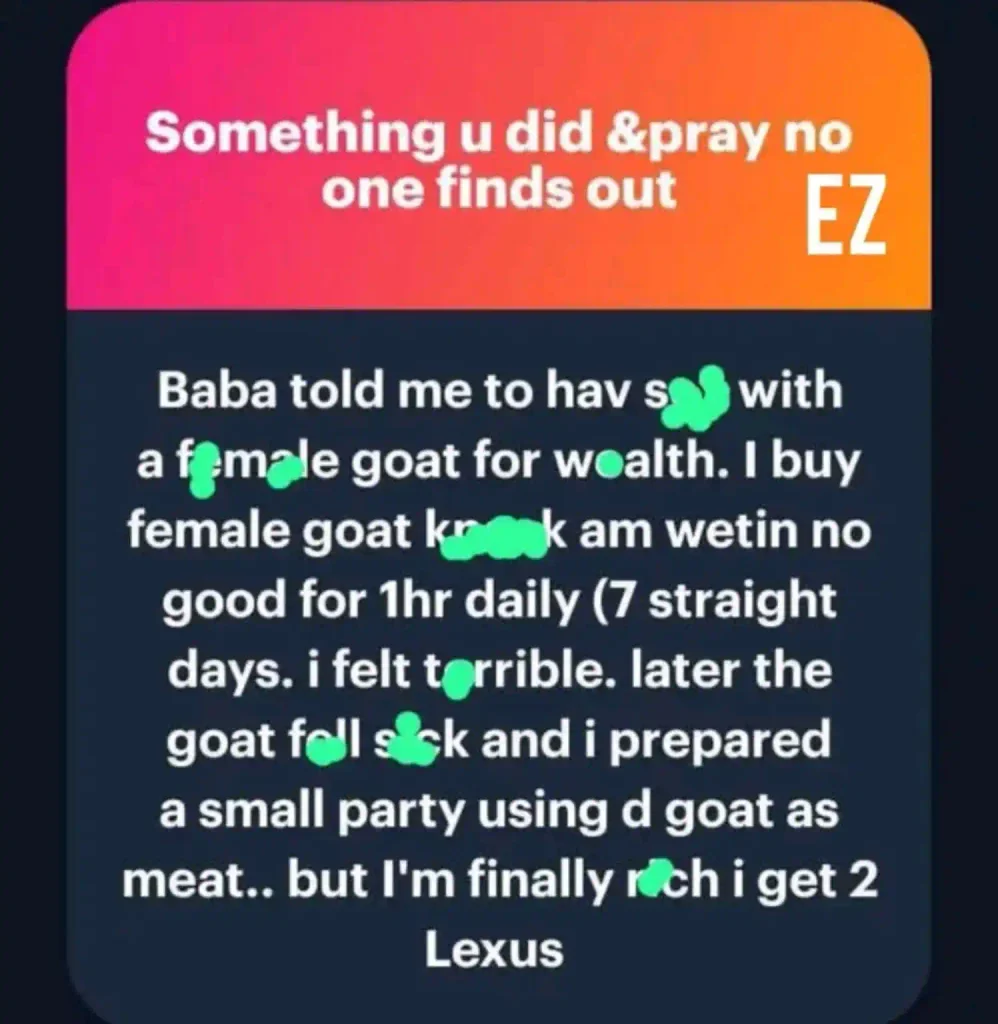
According to the account, the man was told that he needed to follow specific instructions involving a female goat. The practice was to be carried out for one hour each day over seven consecutive days.
Naturally, questions arose. Why a female goat? Why seven days? What exactly was supposed to happen? And how could an activity like that possibly change someone’s financial circumstances?
He could walk away because he did not understand the practice, or he could proceed in the hope that it would bring the breakthrough he desperately wanted.
It is important to understand that people do not always make questionable decisions because they are foolish. Sometimes, they make them because they are under pressure, frightened about the future, or convinced that ordinary opportunities will never be enough.
But a decision made in desperation can carry consequences that the person did not properly consider.
He obtained the female goat and began the practice.
For the first hour, he followed the instructions he had been given. He may have tried to concentrate on the promise that had brought him there in the first place: wealth, a better life, and freedom from financial struggle.
When people make decisions that conflict with their own judgment, they sometimes try to silence their doubts by reminding themselves of the reward they expect to receive.
Perhaps he told himself that he had already started and should finish what he had begun.
He had invested time, money, and emotional energy into the practice. Abandoning it might have forced him to admit that he had placed his trust in something he did not understand.
However, timing alone cannot establish why the goat died. Without reliable information about its condition and cause of death, it would be impossible to conclude that the practice had caused the animal’s illness.
Still, the event became part of his personal account.
But it also raises a practical point: an animal that has died from an unexplained illness should not automatically be treated as safe for consumption. Meat from an animal that dies unexpectedly should be assessed by an appropriate veterinary or food-safety professional.
The story does not establish what caused the goat’s death, and it would be irresponsible to invent an explanation.
One person may see an ordinary gathering. Another may remember the decision that led to it, the doubts that accompanied it, and the strange sequence of events that followed.
But there is no verified evidence in this account that eating the meat or serving it to others had any supernatural effect.
The significance of this episode lies in the questions it leaves behind, rather than in any proven connection between the gathering and what happened next.
At the time, the man could not have known what his financial circumstances would look like months later.
As time passed, the man’s financial circumstances reportedly improved.
He began to experience the kind of progress he had wanted for so long. Opportunities appeared, his situation changed, and he moved closer to the lifestyle he had imagined during his earlier struggles.
The human mind naturally searches for patterns. When something unusual happens before a major change, people often revisit the earlier event to see whether it might explain the later outcome.
But there is a crucial distinction between remembering two events and proving that one caused the other.
His financial progress might have resulted from work, business opportunities, investments, assistance, changing circumstances, or a combination of factors. The available account does not provide enough information to establish the source of his wealth.
Nor does it demonstrate that the seven-day practice caused his financial improvement.
For many people, owning one luxury vehicle is a major financial achievement. Owning two can suggest a level of comfort and purchasing power that attracts attention.
The vehicles became a visible symbol of how far his circumstances had changed.
They did not know every decision he had made, every opportunity he had encountered, or every doubt he might have carried.
And unless they had direct, reliable information, they could not know whether the unusual experience involving the goat had any connection to his financial progress.
This was where the story became particularly interesting.
The two cars provided something tangible for people to talk about. The seven-day practice provided a mysterious episode. Placing the two side by side created a compelling story.
You had spent years wanting to become wealthy. Someone offered you an unusual explanation for how wealth might come. You followed the instructions, experienced the death of the animal involved, and later saw your financial circumstances improve.
There is no independently verified evidence here that the ritual caused the goat’s death, that the goat’s death caused the man’s wealth, or that the two Lexus cars were connected to the practice.
The available account does not establish the man’s exact financial circumstances before and after the experience, the source of the money used to acquire the cars, or the precise timeline of the events.
Without them, anyone claiming to know exactly what happened would be going beyond the evidence.
The most honest conclusion is that the man experienced or reportedly described a sequence of unusual events and later achieved a financial outcome that attracted attention.
Across different societies, people encounter promises of extraordinary riches.
Some are told that a secret investment will make them wealthy within weeks. Others are persuaded to pay for opportunities that cannot be verified. Some are encouraged to follow spiritual claims, while others fall for business schemes disguised as guaranteed success.
They want to believe that their circumstances can change quickly. They want reassurance that their struggles will eventually end.
There is nothing wrong with wanting a better life. The danger begins when the desire for wealth becomes so strong that a person stops asking reasonable questions.
Wealth does not become legitimate merely because it arrives unexpectedly. Nor does an unusual sequence of events prove that someone has discovered a reliable method of becoming rich.
The most dependable route to financial stability generally involves building valuable skills, solving real problems, managing money responsibly, and making decisions based on evidence rather than pressure.
The account of the seven-day practice, the dead goat, and the two Lexus cars is memorable because it combines three powerful elements: desperation, mystery, and apparent success.
But the most useful lesson is not that a particular ritual produces wealth. There is no evidence establishing that claim.
The more important lesson is that people can become vulnerable when they believe that success is available through a secret they have not fully understood.
Desperation can weaken judgment. Secrecy can prevent people from seeking advice. And the appearance of success can make an unverified explanation seem convincing.
Before imitating another person’s decisions, it is important to separate what is known from what is merely suspected.
The man may have his own interpretation of what happened. Other people may have different beliefs about the events. But an honest account must acknowledge the difference between personal interpretation and verifiable fact.
There is also a practical lesson concerning the goat itself. When an animal becomes ill or dies unexpectedly, its condition should be treated as a veterinary and food-safety concern, not automatically interpreted as a spiritual sign.
A serious investigation would begin by asking what can be established, what remains unknown, and what evidence would be needed to reach a reliable conclusion.
That is how we avoid turning uncertainty into misinformation.
Conclusion: Would You Take the Risk?
The story began with a man who wanted to become wealthy.
It continued with an unusual instruction involving a female goat, a seven-day practice, and the animal’s subsequent death.
Later, his financial circumstances reportedly improved, and he acquired two Lexus cars.
The sequence is striking. It is the kind of story that naturally makes people curious.
But the most important question is not whether the events sound mysterious.
It is whether there is enough evidence to establish a connection between them.
At present, there is not.
What remains is a cautionary tale about desperation, belief, uncertainty, and the human desire to find an explanation for extraordinary changes.
The pursuit of wealth can be worthwhile, but it should never require abandoning common sense or accepting an unverified promise without question.
A better life is a reasonable ambition. The challenge is to pursue it without allowing the desire for success to override sound judgment.
Now, consider this question: If someone promised you wealth but asked you to participate in a strange practice you could not fully explain, would you accept the offer—or walk away?
Share your thoughts in the comments.
Editorial note: This article is based on an unverified account and is presented as a cautionary narrative. It does not establish that the ritual caused the animal’s death or the man’s later financial success. Any publication claiming to describe a real individual should verify the events and obtain appropriate permission before identifying that person.