As Nigerians continue to show interest in the ongoing Dangote Refinery Initial Public Offering, many retail investors are considering buying shares with relatively small amounts such as ₦10,000 or ₦20,000.
However, before investing, it is important to understand the difference between dividend income and share-price growth.
A small investment may provide an opportunity to participate in the ownership of a major company, but the amount received through dividends will depend on the company’s future performance and the dividend it eventually declares.
Investors considering Dangote Refinery shares should understand dividends, share-price movements and investment risks.
What Could ₦10,000 or ₦20,000 Earn in Dividends?
To understand the mathematics, let us use an illustrative annual dividend yield of 8.5%.
How Long Would It Take to Receive ₦100,000 Through Dividends Alone?
If the hypothetical 8.5% dividend yield remained unchanged every year and all dividends were paid in cash, the estimated time required to receive a total of ₦100,000 would be as follows:
These figures are mathematical illustrations, not a forecast of Dangote Refinery’s future dividend payments.
They also assume that the dividend yield remains constant, the company continues paying dividends every year and the investor does not reinvest the income. In reality, none of these conditions is guaranteed.
A small shareholding may generate limited dividend income unless the investment grows or more shares are purchased.
Dangote Refinery Has Not Guaranteed an 8.5% Dividend Yield
Investors should not interpret the 8.5% figure as an announced dividend rate from Dangote Refinery.
The official Dangote Refinery IPO information states that dividends are not guaranteed. Dividend payments depend on factors such as the company’s financial performance, cash requirements and decisions by its Board.
Dividend income is the money a company distributes to shareholders from available profits or other legally distributable funds.
Share-price growth occurs when the market value of the shares increases after purchase. An investor may then sell the shares at a higher price, subject to transaction costs and market conditions.
For example, an investor who buys shares worth ₦20,000 could potentially benefit if the market value later rises to ₦25,000. The ₦5,000 difference would represent a potential capital gain before applicable charges and taxes.
However, the opposite can also happen. If the share value falls to ₦15,000, the investor would face a potential capital loss if the shares were sold at that price.
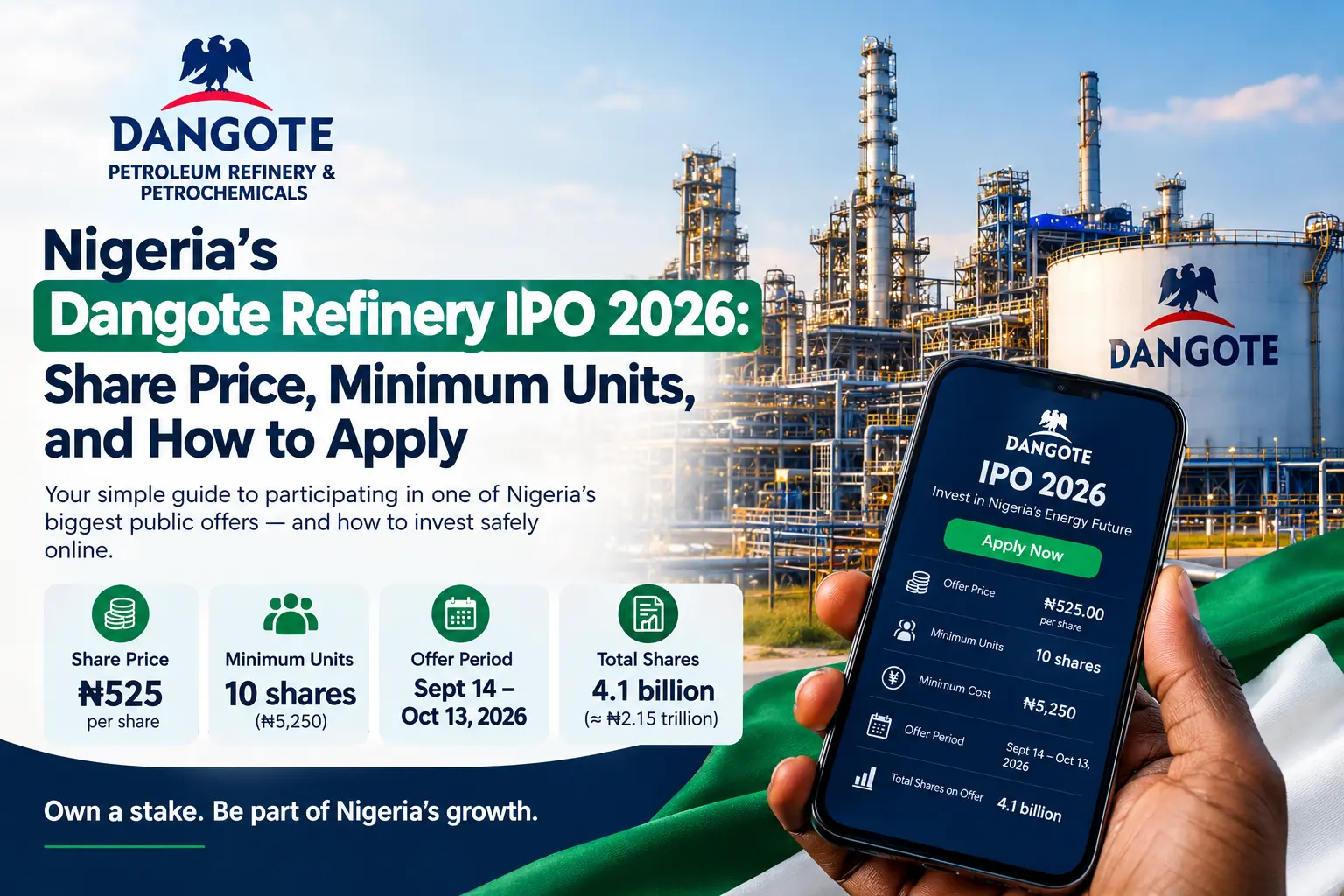
The official Dangote Refinery IPO website lists the offer price at ₦525 per share, with a minimum subscription of 10 shares valued at ₦5,250.
The public offer involves 4.1 billion ordinary shares and is scheduled to run from September 14 to October 13, 2026, subject to the official offer terms.
Because shares are purchased in whole units and transaction charges may apply, the exact number of shares allocated may differ from the simple calculation.
For example, 19 shares at ₦525 would cost ₦9,975, while 38 shares would cost ₦19,950 before any additional charges.
Although ₦10,000 or ₦20,000 may not generate substantial dividend income under the hypothetical example, a small investment can still serve several purposes.
1. It Can Introduce New Investors to the Stock Market
A small investment may allow a first-time investor to learn how public companies, share prices, dividends, brokerage accounts and the Nigerian Exchange operate.
An investor may decide to increase their holdings over time. Additional purchases could increase the amount of dividend income received if dividends are declared.
3. It May Benefit From Share-Price Appreciation
If the company’s market value increases and the shares trade at a higher price, investors may benefit from capital appreciation.
For example, selling pure water, snacks or other fast-moving goods may require:
Finding customers
Buying and managing stock
Transport and storage
Managing daily sales
Handling damaged or unsold goods
Monitoring competition and profit margins
By contrast, a share investment does not normally require the investor to manage the company’s daily operations. However, the investor has less control over the company’s performance and cannot guarantee a particular return.
The choice depends on factors such as the investor’s skills, available time, financial goals, risk tolerance and ability to manage a business.
Important Risks to Understand Before Buying
Share Prices Can Fall
The IPO offer price does not guarantee that the shares will trade above ₦525 after listing. Market prices can rise or fall based on company performance, investor demand, economic conditions and other factors.
Even if an investor receives dividends, inflation may reduce the purchasing power of that income over time.
Investors May Not Receive Their Full Application
If demand exceeds the number of shares available, the final allotment may be lower than the number of shares requested. Investors should review the official allotment terms rather than assume that every application will be fulfilled in full.
Investors should use only approved Receiving Agents and Electronic Application Channels. They should not send money to personal bank accounts or disclose PINs, passwords or one-time passwords to anyone claiming to be an IPO representative.
Questions to Ask Before Investing
Before buying Dangote Refinery shares, investors should ask themselves:
Am I investing for dividends, capital growth or both?
Can I leave this money invested for several years?
Can I afford to lose part or all of the investment?
Have I read the official prospectus?
Do I understand how shares are allotted and traded?
Am I using an approved subscription channel?
Am I relying on a guaranteed return that has not been officially announced?
Frequently Asked Questions
How much dividend can ₦10,000 in Dangote Refinery shares generate?
Using an illustrative 8.5% annual dividend yield, ₦10,000 could generate approximately ₦850 in one year. However, this is only a mathematical example and is not a guaranteed Dangote Refinery dividend.
How much dividend can ₦20,000 in Dangote Refinery shares generate?
Using the same hypothetical 8.5% yield, ₦20,000 could generate approximately ₦1,700 in one year. The actual dividend may be higher, lower or zero.
Is Dangote Refinery offering an 8.5% dividend yield?
There is no basis in the information used for this article to treat 8.5% as a guaranteed or officially declared Dangote Refinery dividend yield. It is used only for illustration.
Can Dangote Refinery shares increase in value?
Yes, the market price may increase after listing, but it may also fall. Share-price performance is not guaranteed.
What is the minimum investment in the Dangote Refinery IPO?
The official IPO information lists a minimum subscription of 10 shares at ₦525 per share, giving a minimum offer value of ₦5,250 before applicable charges.
Are Dangote Refinery dividends guaranteed?
No. The official IPO information states that dividends are not guaranteed and depend on factors including company performance, cash requirements and Board decisions.
Should I invest all my available money in Dangote Refinery shares?
Investors should consider their personal financial circumstances, investment goals and risk tolerance. They should avoid investing money needed for essential expenses and should not rely on guaranteed returns that have not been established.
Conclusion
Buying Dangote Refinery shares with ₦10,000 or ₦20,000 may provide an opportunity to participate in the ownership of a major Nigerian industrial company. However, the amount received through dividends depends on the dividend the company eventually declares.
Using an illustrative 8.5% yield, ₦10,000 would produce approximately ₦850 annually, while ₦20,000 would produce approximately ₦1,700 annually. Under that simplified assumption, it would take about 118 years and 59 years respectively to receive ₦100,000 through dividends alone.
However, stock investment is not limited to dividends. Share-price growth may create capital gains, while a decline in the market price may result in losses.
The 8.5% figure should therefore be treated only as an example. Investors should read the official Dangote Refinery IPO documents, understand the risks and use approved channels before making an investment decision.
Source: Official Dangote Refinery IPO information and publicly available investment information.