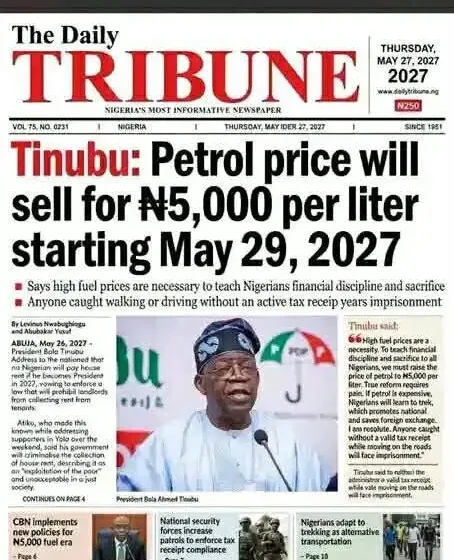
A fabricated newspaper front page claiming that President Bola Ahmed Tinubu has announced a petrol price of ₦5,000 per litre from May 29, 2027, is circulating on social media.
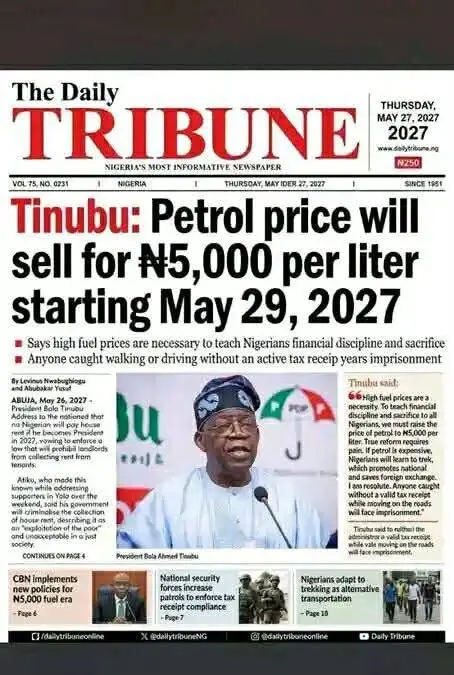
The image looks remarkably similar to a conventional Nigerian newspaper front page. It carries the name “The Daily Tribune,” a large headline about petrol prices, a photograph of President Tinubu and several smaller stories designed to make the publication appear genuine.
FACT CHECK: There is no credible evidence that President Tinubu announced that petrol would sell for ₦5,000 per litre from May 29, 2027. The viral “Daily Tribune” front page is fabricated.
What Does the Viral Newspaper Front Page Claim?
The image circulating online is designed to look like the front page of a newspaper called The Daily Tribune.
The fabricated publication also attributes several other statements to President Tinubu.
Among the claims printed on the fake front page are suggestions that high fuel prices are necessary to teach Nigerians “financial discipline and sacrifice.” It also claims that anyone caught walking or driving without an active tax receipt would face imprisonment.
No credible evidence has been found that President Tinubu made such an announcement.
TheCable Fact Check investigated the viral newspaper designs and reported on September 4, 2026 that the Tinubu-related front page contained fabricated quotes.
The fact-checking organisation specifically identified the headline claiming that petrol would cost ₦5,000 per litre from May 29, 2027 and concluded that the quote attributed to Tinubu was fabricated.
TheCable also reported that there was no record of the president making the statement.
This is important because the headline is written in a way that could easily make readers believe that the Nigerian government has already announced a future petrol price.
The Newspaper Name Is Another Major Red Flag
One of the easiest ways to identify the fake publication is to examine its name.
Nigeria does have the well-known Nigerian Tribune, which is published by African Newspapers of Nigeria PLC.
Tribune Online’s official “About Us” page confirms that it is the online edition of the Nigerian Tribune, Sunday Tribune and Saturday Tribune publications.
That alone should make social media users extremely cautious.
A newspaper supposedly published in May 2027 appearing online in September 2026 is not evidence of a future government policy. It is a strong indication that someone created the image digitally and circulated it as if it were a real publication.
Nigerian Tribune Has Disowned the Fake Publication
The confusion became serious enough for Nigerian Tribune to issue a public disclaimer.
According to TheCable Fact Check, Nigerian Tribune published a disclaimer on September 3, 2026 specifically addressing the fake Tinubu-related front page and described it as fake news.
The official Tribune Online website identifies the legitimate newspaper organisation and its publications. Readers can use the organisation’s official website when checking whether a purported Tribune story or front page is genuine.
This Is Part of a Larger Fake Newspaper Trend
The ₦5,000 petrol story did not appear in isolation.
The emergence of multiple fake newspaper designs suggests that these images are being used as a form of political misinformation during an increasingly active election period.
Fuel prices are an extremely sensitive issue in Nigeria.
Since the removal of the petrol subsidy in 2023, changes in petrol prices have had a direct impact on transportation, food prices, businesses and household expenses.
For example, Nigerian Tribune reported on September 1, 2026 that marketers in Lagos and Ogun were selling petrol at around ₦1,330 per litre amid fresh increases in prices.
That real-world price pressure may make an extreme claim such as ₦5,000 per litre sound believable to some readers.
Most importantly, the viral image itself cannot be treated as evidence.
A genuine presidential announcement about a major petroleum pricing policy would normally be expected to generate reporting across multiple credible news organisations and, where appropriate, official government communications.
For claims involving presidential policies, fuel prices, taxes or major government decisions, check official government communication channels and reputable news organisations.
Why Nigerians Should Not Share the Image as Genuine
Sharing fake news can have consequences beyond simply getting a story wrong.
When people repeatedly see fabricated claims presented as newspaper headlines, they may eventually begin to believe that the statements were actually made.
That is why fact-checking before forwarding is particularly important during an election period.
Before you forward: Stop. Read the headline carefully. Check the date. Search the story. Visit the newspaper’s official website. Then decide whether it is worth sharing.
Bottom Line
The viral image claiming that President Bola Tinubu announced a petrol price of ₦5,000 per litre from May 29, 2027 is fake.
The publication shown in the image uses the name “The Daily Tribune,” which TheCable’s investigation found does not correspond to a Nigerian newspaper organisation. The legitimate Nigerian newspaper is the Nigerian Tribune, published by African Newspapers of Nigeria PLC.
Nigerian Tribune itself has also issued a disclaimer describing the Tinubu-related publication as fake news.
The wider incident is a reminder that social media users should not judge the authenticity of a story simply because it has been designed to look like a newspaper.
Especially with the 2027 elections approaching, Nigerians should expect more fabricated headlines, fake newspaper covers, manipulated screenshots and invented political quotes to circulate online.









[…] Fake Tribune Front Page Claims Tinubu Will Increase Petrol Price to ₦5,000 in 2027 […]
[…] Fake Tribune Front Page Claims Tinubu Will Increase Petrol Price to ₦5,000 in 2027 […]
[…] READ: Fake Tribune Front Page Claims Tinubu Will Increase Petrol Price to ₦5,000 in 2027 […]
[…] Fake Tribune Front Page Claims Tinubu Will Increase Petrol Price to ₦5,000 in 2027 […]