
By Oluwasegun Babafemi | LearnItPedia Technologies
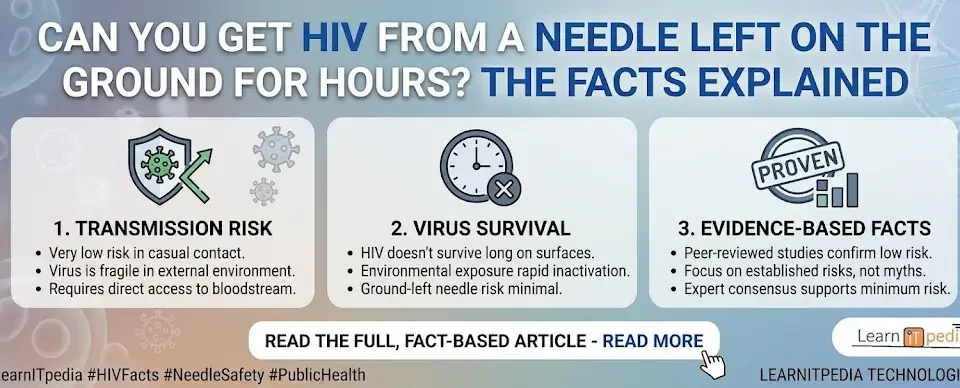
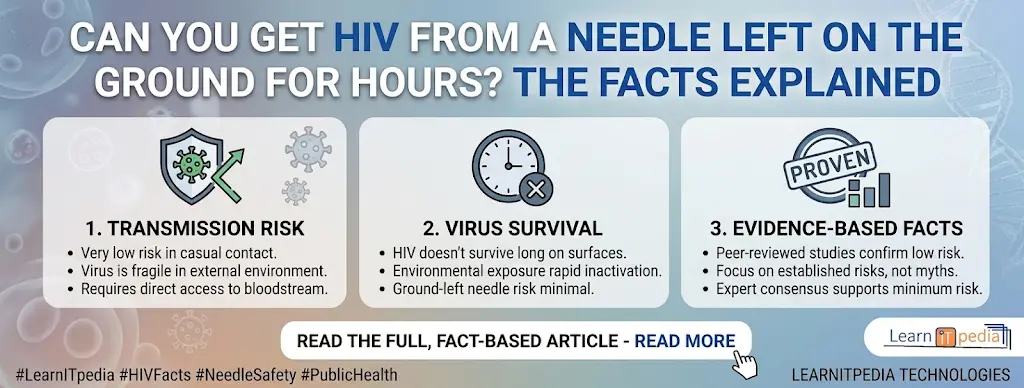
Can someone contract HIV from a needle that has been lying on the ground for several hours? If HIV does not survive well outside the human body, why can a used needle still pose a potential risk?
Table of Contents
These questions often cause confusion, especially when people hear that HIV dies quickly when exposed to air.
The answer is more complicated than saying that HIV survives for only 30 seconds outside the body. HIV does not survive well in the general environment, but blood inside a used syringe can provide conditions that allow the virus to remain infectious for longer than it would on an exposed surface.
Understanding the difference between a discarded needle, a used syringe, and accidental needlestick injuries can help people respond appropriately without unnecessary fear.
Does HIV Die Within 30 Seconds of Exposure to Air?
No. There is no universal 30-second rule that determines exactly when HIV becomes inactive after exposure to air.
HIV is fragile outside the human body, and its ability to remain infectious generally declines as environmental conditions damage the virus. Drying can substantially reduce the amount of infectious HIV, but the rate depends on factors such as the surrounding conditions and the material containing the blood.
Laboratory research has demonstrated that HIV can remain detectable under certain conditions longer than many people expect. However, laboratory findings involving concentrated virus cannot automatically be used to estimate the risk of infection in everyday situations.
The important distinction is that HIV does not survive well on ordinary environmental surfaces, but blood retained inside a needle or syringe can protect the virus from some environmental effects.
The US Centers for Disease Control and Prevention (CDC) explains that HIV does not survive long outside the human body, while also recognising that used syringes can retain conditions that allow HIV to remain infectious.
Source: https://www.cdc.gov/hiv/causes/index.html
Why Can a Needle Still Carry HIV After Several Hours?
To understand this, it is important to distinguish between a needle exposed directly to the environment and a needle attached to a syringe containing residual blood.
1. Blood inside a syringe may be protected
When a syringe has been used, a small amount of blood may remain inside its barrel, needle hub, or needle.
Not all the blood is necessarily exposed directly to the surrounding air. Some residual blood may remain within the equipment, where environmental conditions differ from those on an open surface.
If the blood contains HIV, the virus may remain infectious under suitable conditions.
The length of time it remains infectious varies. Temperature, the amount of residual blood, the design of the equipment, and other environmental factors can influence survival.
2. Drying reduces HIV infectivity, but it is not an instant switch
When blood dries, HIV infectivity declines substantially. However, that decline is not governed by a fixed countdown that applies to every needle.
A needle that has been lying exposed on a hot, dry surface is not necessarily equivalent to a syringe containing residual blood in a protected space.
For this reason, you should never assume that a used needle is safe simply because several hours have passed.
3. A needle puncture is different from touching a surface
HIV transmission requires an appropriate route of exposure. Simply touching an ordinary surface does not transmit HIV.
A contaminated needle that penetrates the skin presents a different situation because it can introduce blood directly into tissue.
However, the existence of a possible route of exposure does not mean that every discarded needle contains infectious HIV or that every needlestick injury causes infection.
Can You Get HIV from a Discarded Needle Found on the Ground?
The risk from a discarded needle in a community setting is considered very low, although an injury should still be assessed by a healthcare professional.
The CDC’s 2025 guidance on post-exposure prophylaxis states that HIV post-exposure medication is not routinely recommended following accidental injuries from discarded needles in community settings, except in exceptional circumstances. The guidance notes that there are no confirmed reports of HIV acquisition through this route.
An injury involving a freshly blood-contaminated needle may require a different assessment from one involving an old, weathered needle with no visible blood.
The circumstances matter, including how the injury occurred, whether blood was present, the type of needle, and the possible source of the blood.
This is why it is not accurate to claim either that every discarded needle is dangerous or that every discarded needle is completely harmless.
If a needle penetrates your skin, seek medical advice promptly rather than attempting to calculate the risk based only on how long the needle may have been on the ground.
Source: https://pmc.ncbi.nlm.nih.gov/articles/PMC12064164/
What If a Needle Has Been on the Ground for Several Hours?
Suppose someone finds a needle that may have been used earlier in the day and accidentally pricks their finger.
Does the time that has passed eliminate the risk?
Not necessarily. Time and environmental exposure can reduce the likelihood that HIV remains infectious, but the exact risk cannot be determined from elapsed time alone.
At the same time, an accidental injury from a discarded community needle should not automatically be treated as equivalent to a needlestick involving a freshly used syringe containing blood from a person with HIV.
Healthcare professionals assess the circumstances and determine whether preventive treatment or follow-up testing is appropriate.
There is also another important concern: discarded needles can carry other bloodborne infections, including hepatitis B and hepatitis C. These infections have different characteristics and must be considered separately.
What Should You Do If a Used Needle Pricks You?
If a used needle penetrates your skin, take the following steps.
Step 1: Wash the affected area
Wash the wound gently with soap and running water.
Do not suck the wound, aggressively scrub it, or apply bleach or other harsh chemicals to the injury.
Step 2: Seek medical attention immediately
Visit a hospital or other appropriate healthcare facility as soon as possible. Explain how the injury happened, when it occurred, and whether you noticed blood on the needle.
Do not delay seeking care while trying to determine whether the needle was infectious.
Step 3: Ask whether HIV post-exposure prophylaxis is appropriate
Post-exposure prophylaxis, commonly called PEP, involves taking HIV medicines after a possible exposure to help prevent infection.
PEP should be started as soon as possible, ideally within 24 hours, and no later than 72 hours after a potential exposure under current guidance.
A healthcare professional will assess whether PEP is appropriate for the specific circumstances. Not every discarded-needle injury requires it, but an individual assessment is important.
When prescribed, the usual course lasts 28 days.
If more than 72 hours have passed, seek medical advice anyway. A clinician can advise you about testing and other appropriate follow-up care.
Sources:
- https://www.hiv.gov/hiv-basics/hiv-prevention/using-hiv-medication-to-reduce-risk/post-exposure-prophylaxis
- https://www.who.int/news/item/22-07-2024-who-updates-guidelines-to-enhance-access-to-hiv-post-exposure-prophylaxis
Step 4: Follow the recommended testing schedule
An initial HIV test may help establish your status at the time of the incident, but it cannot immediately rule out infection resulting from a very recent exposure.
A healthcare professional can recommend appropriate follow-up HIV testing and assess whether hepatitis B or hepatitis C testing or preventive measures are needed.
Do not rely on the absence of symptoms to determine whether an infection occurred.
What About the Quora Story of a Caregiver Who Was Pricked by a Needle?
A discussion on Quora raised this question through the account of a caregiver who accidentally pricked their hand with a needle previously used in medical care for a partner living with HIV.
The caregiver described being frightened, receiving reassurance from a friend, and subsequently not developing HIV.
The story illustrates how stressful an accidental needlestick can be, but an individual experience cannot establish the exact survival time of HIV or prove that every similar injury is safe.
The outcome of a potential exposure depends on several factors, including whether the source had transmissible HIV, whether infectious blood was present, the nature of the injury, and whether preventive treatment was used.
The story also does not establish whether the caregiver underwent appropriate follow-up testing.
The practical lesson is not to panic, but also not to rely on reassurance alone. Prompt medical assessment is the safest response to a potentially significant exposure.
Can Mosquitoes Transmit HIV?
No. Mosquitoes do not transmit HIV.
Although mosquitoes can spread other infections, such as malaria, HIV does not reproduce inside mosquitoes in the way required for transmission.
A mosquito bite also does not inject another person’s blood into your body. The insect feeds on blood, but its feeding process does not make it a vehicle for HIV transmission.
HIV is transmitted through specific body fluids and routes, including certain sexual exposures, sharing contaminated injection equipment, and transmission during pregnancy, childbirth, or breastfeeding.
Ordinary social contact, touching, hugging, and sharing everyday objects do not transmit HIV.
For more information, visit the CDC’s HIV transmission guidance: https://www.cdc.gov/hiv/causes/index.html
How Can You Prevent Accidental Needlestick Injuries?
Prevention is particularly important in healthcare facilities, homes where injectable medicines are used, and public spaces where discarded sharps may be found.
- Never pick up a discarded needle with your bare hands.
- Keep used needles away from children and other people.
- Place used medical sharps in an appropriate sharps container.
- Never reuse or share needles or syringes.
- If you find a discarded needle in a public area, keep others away and contact the appropriate local health or waste-management service for safe removal.
- Healthcare workers should follow established sharps-handling and disposal procedures.
These precautions help reduce exposure to HIV and other infections that can be transmitted through contaminated blood.
Frequently Asked Questions
Can HIV survive outside the human body for hours?
Under certain conditions, HIV can remain infectious outside the body for longer than a few seconds. However, its infectivity declines, especially as blood dries. Survival varies with the environment and whether blood remains inside equipment such as a syringe.
Is a needle safe after 30 seconds?
There is no reliable universal 30-second rule. Do not assume that a used needle is safe based on a specific number of seconds or minutes.
Can a needle left on the ground for hours transmit HIV?
The risk from an accidental injury involving a discarded community needle is considered very low, and no confirmed HIV transmissions through this route are documented in the cited CDC guidance. Nevertheless, a puncture injury should be assessed promptly, especially if the needle was freshly contaminated with blood.
What is the deadline for starting HIV PEP?
PEP should be started as soon as possible, ideally within 24 hours and no later than 72 hours after a potential exposure. A healthcare professional should assess whether treatment is appropriate.
Can I get HIV by touching a needle without being pricked?
Touching a needle without a puncture or contact between infectious blood and a relevant entry point does not ordinarily constitute an HIV transmission exposure. If you are unsure whether the skin was broken or blood contacted your eyes, mouth, or damaged skin, seek medical advice.
Final Thoughts
The belief that HIV dies within exactly 30 seconds of exposure to air oversimplifies how the virus behaves outside the human body.
HIV does not survive well in the general environment, and accidental injuries from discarded community needles present a very low risk of HIV transmission. However, blood retained inside used injection equipment can provide conditions in which the virus remains infectious for longer.
The safest approach is to understand the difference between theoretical possibility and actual risk, avoid handling discarded needles, and seek prompt medical care after a needlestick injury.
Important health notice: This article is for general educational purposes and is not a substitute for professional medical advice, diagnosis, or treatment. Anyone who may have experienced a significant HIV exposure should seek immediate medical assessment.
About LearnItPedia Technologies: LearnItPedia shares educational information, practical technology resources, career guidance, and useful learning opportunities to help readers make informed decisions.
You May Also Like:





You May Also Like:



[…] ALSO READ: Can You Get HIV from a Needle Left on the Ground for Hours? The Facts Explained […]