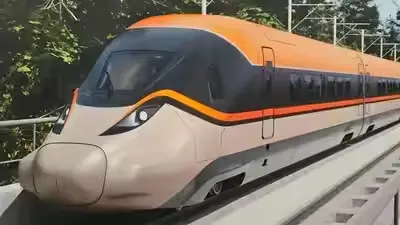
India is taking another major step towards becoming a high-speed rail manufacturing nation, with Indian Railways preparing to roll out an indigenously designed and manufactured high-speed train capable of a design speed of 280 kmph.
The development comes nearly a decade after India’s first bullet train project was launched in 2017. According to a recent report by The Times of India, the first prototype of the new Indian high-speed train is targeted for rollout by March 2027.
The project is being developed by BEML Limited under a contract awarded by Integral Coach Factory (ICF), Chennai. The contract is worth approximately ₹866.87 crore and covers the design, manufacture and commissioning of two prototype high-speed trainsets.
India’s indigenous high-speed train is being designed for a speed of 280 kmph, with the first prototype expected to be rolled out for extensive testing by March 2027.
India’s Own High-Speed Train Is Taking Shape
For years, India’s bullet train ambitions have been closely associated with the Mumbai-Ahmedabad High-Speed Rail project and Japanese Shinkansen technology.
However, India is now working towards developing its own high-speed train technology.
The new trainsets represent an important part of that effort. Rather than relying entirely on imported rolling stock, Indian companies are being involved in the development and manufacturing process.
BEML Limited has been tasked with producing two prototype trainsets, each consisting of eight cars.
According to BEML’s announcement, the contract includes the design, manufacturing, supply, testing and commissioning of the trainsets. The company says the project will result in India’s first indigenously designed and manufactured high-speed trainsets with a test speed of 280 kmph.
BEML says the contract includes design costs, one-time development costs, non-recurring charges, tooling, jigs, fixtures and testing facilities. These facilities are expected to support future high-speed rail projects in India.
This means the project is also an investment in India’s ability to develop and manufacture high-speed railway technology domestically.
BEML’s project announcement describes the trainsets as having a test speed of 280 kmph, while the latest reporting on the project says the trains will be capable of crossing 250 kmph and have a design speed of 280 kmph.
For comparison, this places the proposed train firmly in the high-speed rail category and significantly above India’s conventional passenger trains.
The project is also expected to provide Indian engineers and manufacturers with valuable experience in designing, testing and producing trains for future high-speed corridors.
The Times of India reports that the first prototype is targeted for rollout by March 2027. After rollout, the train will undergo extensive testing by the Research Designs and Standards Organisation (RDSO).
This testing phase will be critical because a train designed to operate at very high speeds must meet strict requirements for stability, braking, safety and passenger comfort before entering commercial service.
BEML had previously announced that the two trainsets were scheduled for delivery by the end of 2026.
Facilities for passengers with restricted mobility.
Onboard infotainment systems.
Modern passenger amenities.
The combination of high speed and modern passenger facilities is intended to create a significantly different travel experience from conventional Indian railway services.
High-speed rail requires sophisticated technology covering areas such as train design, propulsion, braking, aerodynamics, passenger safety, signalling and track compatibility.
Successfully developing the prototype could therefore provide Indian manufacturers with experience that can be applied to future high-speed rail projects.
🇮🇳 What the Project Could Mean for India
Greater domestic capability in high-speed train manufacturing.
More experience for Indian railway engineers.
Potential reduction in dependence on imported trainsets over time.
Development of technology that could support future high-speed corridors.
Growth of India’s railway manufacturing ecosystem.
The Mumbai-Ahmedabad corridor remains India’s first dedicated high-speed rail project, while the indigenous BEML trainsets represent a separate but related technological development within India’s wider high-speed rail ambitions.
The Times of India reports that the first section of the Mumbai-Ahmedabad bullet train corridor is expected to become operational in 2027, with the Surat-Bilimora section targeted for August that year.
The development of an indigenous 280 kmph train comes as India continues to expand its plans for high-speed rail.
The country is not looking at the Mumbai-Ahmedabad corridor as the end of its high-speed railway ambitions. Several additional corridors have been proposed at different stages of development.
Developing domestic train manufacturing capability could become increasingly important if India eventually needs large numbers of high-speed trainsets for these routes.
Instead of depending exclusively on foreign manufacturers, Indian companies could potentially play a much larger role in supplying future fleets.
It is important to understand that the planned 2027 rollout does not automatically mean passengers will immediately be able to buy tickets and board the train.
The first trainsets are prototypes and will need to go through testing and validation.
High-speed trains require extensive testing before commercial operations can begin. Engineers need to evaluate their performance under different operating conditions and confirm that the train meets the required safety and technical standards.
Therefore, the March 2027 rollout should be viewed as an important development and testing milestone rather than an announcement of immediate nationwide passenger service.
The Times of India reports that the country’s high-speed train development is planned in stages. The initial trainsets are being designed around a 280 kmph capability, while subsequent trainsets are expected to eventually have the capability to reach 350 kmph.
If that development progresses successfully, India could gradually build the expertise required to compete in the global high-speed rail manufacturing sector.
The project is also significant from the perspective of India’s broader Make in India manufacturing strategy.
BEML is a government-owned company operating under India’s Ministry of Defence and has experience across defence, mining, construction, rail and metro manufacturing.
Its involvement in the high-speed train project gives an Indian manufacturer the opportunity to develop technology and production capabilities that could be useful beyond the two prototype trains.
BEML has also stated that some of the development, tooling and testing facilities covered by the contract are intended to be utilised for future high-speed projects in India.
The immediate focus will be on completing the prototype trainsets and preparing them for testing.
The first major milestone is the planned rollout by March 2027. The train will then undergo extensive testing and evaluation before any decision on wider deployment.
The ₹866.87 crore BEML project covers two eight-car prototype trainsets designed for a test speed of 280 kmph. The first prototype is targeted for rollout by March 2027, followed by extensive testing.
The development is important because it could help India build domestic expertise in high-speed railway technology while preparing the country’s manufacturing industry for future high-speed rail corridors.
Nearly a decade after India’s bullet train project was launched in 2017, the country is now attempting to take another major step: not just operating high-speed trains, but building its own.
🚄 What Do You Think?
Would you travel on a 280 kmph train if India eventually brings the service to more cities?









[…] India to Roll Out Indigenous 280 kmph Bullet Train by 2027 After ₹866.87 Crore Project […]
[…] India to Roll Out Indigenous 280 kmph Bullet Train by 2027 After ₹866.87 Crore Project […]