The workplace is changing faster than ever. According to the World Economic Forum, 39% of the key skills required in the job market are expected to change by 2030, and employers are already prioritizing skills over degrees and job titles. For professionals looking to future-proof their careers, 2027 is the year to get ahead of the curve. Digital skills to learn in 2027.
Table of Contents for Digital skills to learn in 2027
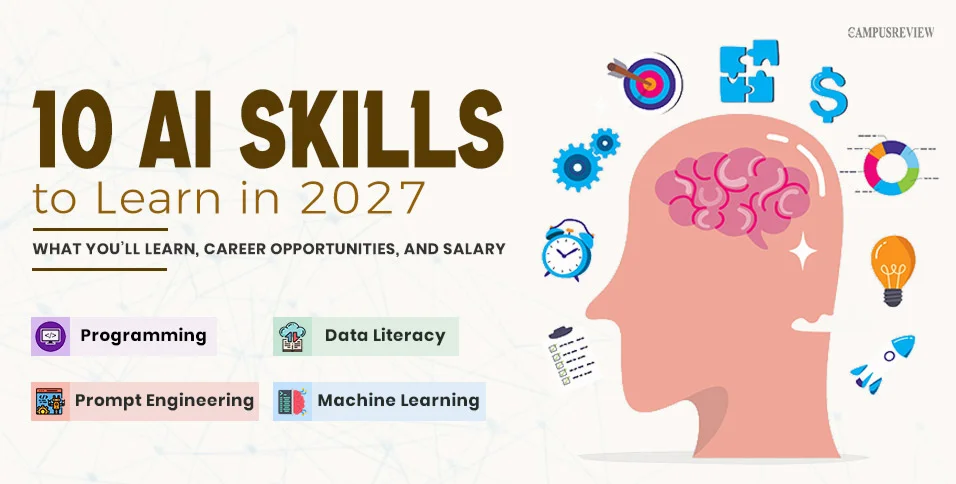
The most in-demand digital skills are no longer just about coding or knowing a specific software. They are about adaptability, critical thinking, and the ability to leverage technology to solve real business problems. Here are the 10 digital skills that will define career success in 2027.
AI literacy is no longer optional. It is about understanding what AI can and cannot do, how to use it responsibly, and where its limitations lie. A 2026 report found that 21% of employed Americans already use AI in some capacity at work, and that number is rising fast.
Employers want professionals who can use AI tools appropriately, verify their outputs, and protect sensitive information. This skill is becoming a baseline requirement across industries, not just in tech roles.
Prompt engineering is not simply “typing questions.” It is the ability to structure context, constraints, and objectives so that AI tools produce usable, accurate, and relevant output. LinkedIn’s Skills on the Rise report identified prompt engineering as a fast-growing skill appearing across HR, marketing, sales, and consulting roles.
As companies integrate AI into everyday workflows, professionals who can communicate effectively with AI systems will have a distinct advantage.
Knowing how to chat with AI is one thing. Connecting it to real business processes is another. AI workflow automation involves integrating AI tools into existing systems to streamline tasks, reduce manual work, and improve efficiency [citation:1].
This skill is particularly valuable in operations, administration, and project management, where repetitive tasks can be automated to free up time for higher-value work.
Data literacy extends far beyond specialist roles. While data scientist employment is projected to grow by 33.5% between 2024 and 2034, professionals in every field now need to interpret trends, question assumptions, and communicate findings [citation:5].
Employers are prioritizing candidates who can move beyond analysis to application—extracting insight from data and using it to guide real decisions. This skill is showing up in business development, sales, HR, marketing, and consulting roles [citation:11].
Research from the National Skills Coalition found that 92% of jobs analyzed required digital skills, and data visualization is one of the most practical applications [citation:12]. The ability to create charts, dashboards, and visual reports that help teams understand performance trends and communicate findings to decision-makers is increasingly valuable.
LinkedIn data shows that job postings requesting storytelling skills have doubled in the past year, highlighting how important it is to translate complex data into clear, compelling narratives .
Cybersecurity is no longer just the responsibility of IT departments. Employment for information security analysts is projected to grow by 28.5% from 2024 to 2034, but employees outside cybersecurity roles also need to understand secure data handling, access controls, and common digital threats [citation:5].
As remote work and cloud-based operations become standard, every professional needs a baseline understanding of how to protect sensitive information and recognize potential security risks.
Eurostat reported that 40% of EU citizens lacked at least basic digital skills in 2025 [citation:5]. But digital adaptability goes beyond knowing how to use a specific tool. It is the ability to learn unfamiliar software, navigate new digital platforms, and respond to changing job requirements.
Korn Ferry’s 2027 talent report ranked adaptability as the number one workforce skill, noting that being adaptable to what jobs require next is amplified when coupled with critical thinking and collaboration [citation:6].
You do not need to be a senior developer to benefit from AI-assisted coding. The ability to build, test, and ship faster using AI tools is becoming valuable across technical and non-technical roles alike. AI is automating coding, and software developers are increasingly becoming AI engineers who verify AI-derived code and ensure compliance [citation:9].
For professionals in tech-adjacent roles, understanding how to work with AI coding assistants can significantly boost productivity.
AI can be confidently wrong. Knowing how to catch errors, evaluate outputs, and apply human judgment is a critical skill that employers value highly. Among workers who used AI chatbots at work, 40% said the tools were helpful for completing tasks faster, but only 29% reported similar benefits for work quality [citation:5].
Professionals who can critically assess AI-generated content rather than accepting it at face value will be essential for maintaining quality and accuracy in any organization.
The future is not about AI experts replacing everyone. It is about domain experts who know how to leverage AI outperforming those who do not. This concept, often called “skill stacking,” combines your existing expertise with AI capabilities [citation:1].
AI + Marketing. AI + Finance. AI + Design. AI + Healthcare. Professionals who can apply AI tools to their specific domain will be uniquely positioned to drive value in their organizations. LinkedIn’s 2026 report emphasizes that narrow specialization is out, and skill stacking is the new standard [citation:8].
Korn Ferry’s research found that 77% of leaders say capability gaps will be a greater challenge than talent shortages, and 78% say too few people are prepared for how work will be done in the future [citation:6]. The organizations that thrive will be those with employees who can adapt, learn quickly, and combine technical fluency with human judgment.
LinkedIn’s Skills on the Rise report shows that skills-based hiring is accelerating. Companies are looking less at job titles or degrees and more at what people can actually do [citation:4]. The ten skills listed above represent the fastest-growing areas where professionals should invest their learning time.
You do not need to master all ten skills at once. The most practical approach is to identify the skills most relevant to your current role and future goals, then set a specific learning objective. LinkedIn Learning, Coursera, and other platforms offer courses in AI literacy, prompt engineering, data analysis, and more.
Start with AI literacy and data interpretation—these are foundational skills that apply across every industry. Then, layer on domain-specific AI applications that align with your career path. Waiting until 2027 to learn 2027’s skills is the biggest mistake you can make. Start today.