Nigerian lawmakers sexual misconduct: Three Nigerian lawmakers were accused of sexual misconduct during an official visit to the United States in 2016, triggering an investigation by the Nigerian House of Representatives and a diplomatic controversy between Nigeria and the United States.
Table of Contents
The allegations were made by then-U.S. Ambassador to Nigeria James Entwistle in a June 9, 2016 letter addressed to the Speaker of the House of Representatives, Yakubu Dogara.
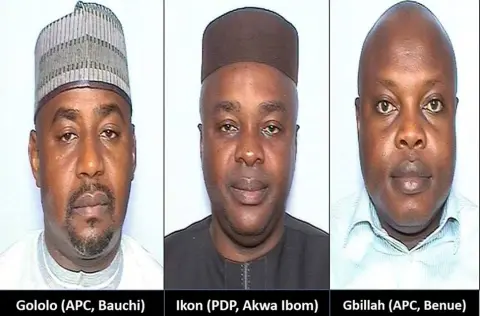
The three lawmakers named were Mohammed Garba Gololo of Bauchi State, Samuel Ikon of Akwa Ibom State and Mark Terseer Gbillah of Benue State.
The 2016 allegations involved three Nigerian members of the House of Representatives who travelled to the United States for an official programme.
What happened during the US trip?
The lawmakers were among a delegation of 10 members of Nigeria’s National Assembly who travelled to Cleveland, Ohio, to participate in the U.S. Government’s International Visitor Leadership Program on good governance.
According to the original Sahara Reporters report, the programme took place in April 2016. The allegations later became the subject of an official investigation in Nigeria.
In his letter to Dogara, Ambassador Entwistle said the U.S. Department of State and the Cleveland Council on World Affairs had received reports from employees of the hotel where the Nigerian delegation stayed.
The ambassador also alleged that Mark Gbillah and Samuel Ikon requested the assistance of hotel parking attendants to solicit prostitutes.
These were allegations contained in the ambassador’s letter and were not established facts at the time they were reported. The original Sahara Reporters article itself presented them as accusations.
Why did the allegations become a diplomatic issue?
Ambassador Entwistle expressed concern that the reported conduct could damage Nigeria’s image and affect future participation by Nigerian officials in similar U.S. government programmes.
He also raised concerns about the possible impact on the International Visitor Leadership Program and relations between Nigerian officials and their American hosts.
According to the ambassador’s letter, the U.S. side considered the reported behaviour serious enough to potentially affect future participation in similar programmes.
Mark Gbillah demanded that evidence supporting the allegations be produced and reportedly sought CCTV footage covering the period of the delegation’s stay at the hotel.
Mohammed Garba Gololo also rejected the allegation against him and described it as false and unfounded.
The lawmakers were also formally given an opportunity to respond to the allegations. Contemporary reporting stressed that they remained innocent unless wrongdoing was established.
What happened to the investigation?
The investigation continued for several months and included consideration of whether evidence existed to substantiate the allegations.
In July 2016, Nigeria’s then-Minister of Foreign Affairs, Geoffrey Onyeama, said the U.S. ambassador had not provided concrete evidence to establish the allegations, according to reporting by PUNCH.
The ambassador was also expected to appear before the investigating committee and provide evidence during the public proceedings, but he did not appear at one of the scheduled hearings.
In October 2016, the House of Representatives adopted the report of its investigative committees and cleared Mohammed Garba Gololo, Mark Terseer Gbillah and Samuel Ikon of the allegations.
The committee said it had not been provided with concrete evidence sufficient to substantiate the accusations. Reports stated that the U.S. ambassador did not appear before the committee to present the expected evidence, while the alleged hotel employee also did not testify before the panel.
The House therefore cleared the three lawmakers for lack of evidence and recommended that Nigeria’s Foreign Affairs Ministry engage with the U.S. ambassador over the matter.
What was the final position of the House?
The House’s resolution stated that the three lawmakers were cleared and exonerated of the allegations contained in the U.S. ambassador’s June 9, 2016 letter.
The House also recommended that the Ministry of Foreign Affairs remind the U.S. Embassy about the appropriate official channels for communication with Nigerian government institutions.
This means the 2016 controversy should be reported with an important distinction: the allegations were made, investigated and subsequently rejected by the Nigerian House of Representatives for want of evidence.
The episode attracted considerable attention because it involved elected Nigerian officials participating in an international government-sponsored programme and generated questions about diplomatic communication, accountability and the reputation of public officials abroad.
It also demonstrated the importance of distinguishing an allegation from an established finding. The initial reports concerned accusations made by a U.S. ambassador, while the subsequent Nigerian parliamentary investigation reached a different conclusion after considering the available evidence.
Key facts about the 2016 controversy
Year: 2016
Location of reported incidents: Cleveland, Ohio, United States
Programme: International Visitor Leadership Program on good governance
Number of Nigerian lawmakers in the delegation: 10
Lawmakers accused: Mohammed Garba Gololo, Samuel Ikon and Mark Terseer Gbillah
Person who made the allegations: James Entwistle, then-U.S. Ambassador to Nigeria
Nigerian institution that investigated the matter: House of Representatives
Outcome: The House cleared the three lawmakers for lack of evidence in October 2016
Frequently Asked Questions
Which Nigerian lawmakers were accused of sexual misconduct in the US in 2016?
The lawmakers were Mohammed Garba Gololo of Bauchi State, Samuel Ikon of Akwa Ibom State and Mark Terseer Gbillah of Benue State.
Who made the allegations?
The allegations were made by James Entwistle, who was the United States Ambassador to Nigeria at the time. He communicated the allegations in a June 9, 2016 letter to House Speaker Yakubu Dogara.
The allegations stated that Mohammed Garba Gololo allegedly grabbed a hotel housekeeper and solicited her for sex, while Mark Gbillah and Samuel Ikon were accused of asking hotel parking attendants to help them solicit prostitutes.
Did the lawmakers admit the allegations?
No. The three lawmakers denied the allegations and challenged the claims made against them.
Did the Nigerian House of Representatives investigate the allegations?
Yes. The House directed its Committees on Ethics and Privileges and Foreign Relations to investigate the allegations.
Were the lawmakers eventually cleared?
Yes. In October 2016, the House of Representatives adopted the investigative committee’s report and cleared the three lawmakers, citing a lack of sufficient evidence to establish the allegations.
Is the original Sahara Reporters story still available?